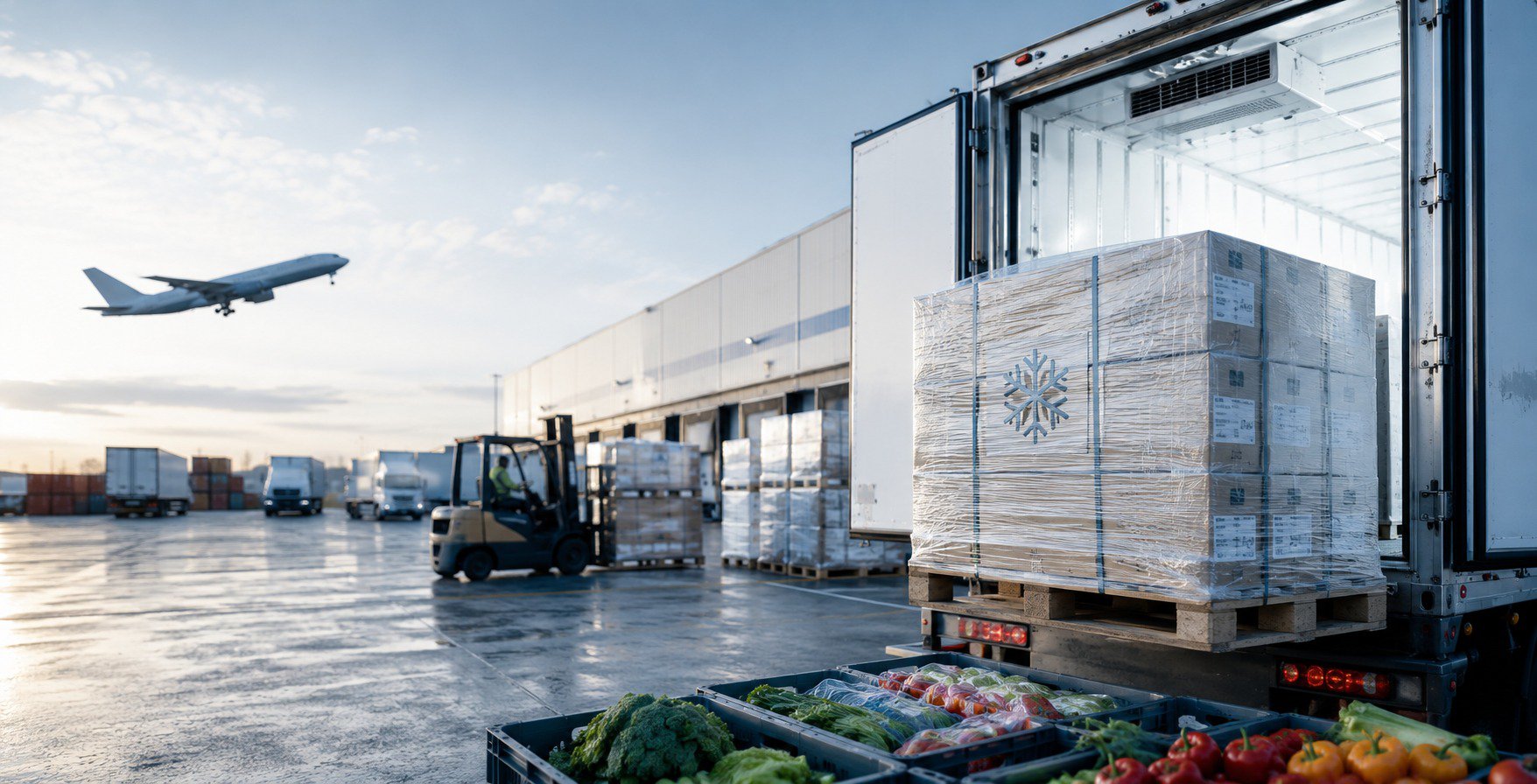


If your business sells products that can spoil, melt, wilt, or lose quality over time, logistics becomes a lot more important. A delay of just a few hours or a small temperature change can turn perfectly good inventory into waste.
That's where a 3PL for perishable goods comes in.
These specialized logistics providers help businesses store, manage, and ship temperature-sensitive products while keeping them fresh and safe.
Instead of investing in warehouses, refrigeration equipment, trucks, and logistics staff, companies can outsource those tasks to experts who already have the infrastructure in place.
In this post, we'll take a closer look at how perishable goods 3PL services work and why so many businesses rely on them.
A perishable goods 3PL offers a wide range of services designed to protect products from the moment they enter storage until they reach the final customer.
Here are the most important ones:
One of the most important services is temperature-controlled storage.
Perishable products often require specific temperature ranges to remain fresh and safe. A refrigerated warehouse can keep products chilled, while frozen storage facilities maintain temperatures well below freezing.
These facilities are equipped with monitoring systems that track temperatures around the clock.
If conditions start to change, warehouse teams can respond immediately before products are affected.
The better 3PL cold storage providers document those responses rather than just logging the reading. Continuous monitoring with an audit trail is what proves a shipment held its range, and it is the difference between a facility that meets food safety standards on paper and one that can show it.
Also Read: How To Maintain Cold Chain During Transport
This level of control helps businesses avoid spoilage, reduce waste, and maintain product quality throughout the storage process. You can see how we approach it across our temperature-controlled warehousing facilities.
Maintaining the cold chain matters just as much as the storage on either end of it.
A shipment might leave a refrigerated warehouse in perfect condition, but if temperatures rise during transportation, product quality can suffer.
Perishable goods 3PL providers use refrigerated trucks, insulated containers, and temperature monitoring technology to keep products within the required range throughout transit.
This is also a regulated activity, not just an operational one. The FDA's Sanitary Transportation of Human and Animal Food rule sets requirements for shippers, loaders, carriers, and receivers covering vehicles, transportation operations, temperature controls, records, and training.
Many providers also offer real-time tracking, allowing businesses to monitor shipments and identify potential issues before they become major problems.
Managing inventory can be challenging when products have expiration dates and shelf lives.
Perishable goods 3PL companies use inventory systems that help track stock levels, expiration dates, product movement, and storage conditions. This allows businesses to rotate inventory properly and ship older stock before newer inventory.
For perishable goods, that rotation usually runs on First-Expired-First-Out (FEFO) rather than simple First-In-First-Out, because the lot received first is not always the lot that expires first. When inventory arrives with mixed remaining shelf life, receipt date and expiration date pull in different directions, and FEFO is what keeps the right pallet moving.
This approach helps minimize waste and keeps products moving efficiently through the warehouse.
Good inventory management can have a significant impact on profitability because fewer products end up being discarded due to expiration or spoilage.
Order fulfillment involves picking, packing, and shipping products to customers.
For perishable goods, fulfillment requires extra care. Products often need specialized packaging, insulated materials, cooling packs, or expedited shipping methods.
A good 3PL team understands these requirements and can prepare orders in a way that helps maintain freshness.
This can be especially valuable for businesses that sell directly to consumers, grocery stores, restaurants, or retail chains.
Working with a 3PL offers several advantages that go beyond simply storing products.
First, businesses can reduce spoilage and waste.
Since perishable goods require careful handling, experienced logistics providers can help prevent losses caused by temperature fluctuations, poor storage practices, or shipping delays.
Another major benefit is cost savings.
Also Read: Best Air Freight Charter For Urgent Perishable Shipments?
Building and maintaining refrigerated warehouses, purchasing cooling equipment, and operating temperature-controlled transportation systems can be incredibly expensive. Outsourcing those functions allows businesses to access professional infrastructure without making huge investments.
Scalability is another reason companies choose a 3PL.
As demand grows, businesses can increase storage space and shipping capacity without needing to build new facilities or hire additional staff.
Many providers also help businesses stay compliant with industry regulations. For imported perishables, that extends past the warehouse into entry filing, agency coordination, and documentation review, which is why some providers keep licensed customs brokerage in house rather than subcontracting it.
Perhaps most importantly, partnering with a specialized provider allows business owners to focus on sales, marketing, product development, and customer service instead of managing logistics operations.
Perishable goods are products that can deteriorate, spoil, or lose quality if they are not stored properly or delivered within a certain timeframe.
Some of the most common examples include:
Many people immediately think about food when they hear the word "perishable," but plenty of other products also require controlled environments and careful handling.
And because these products have limited shelf lives, businesses must move them through the supply chain efficiently.
Also Read: What to expect from full-service logistics providers?
Many industries rely heavily on perishable goods logistics.
Some of the most common include:
Cut flowers and live plants are a useful example of how much sits outside the temperature question alone. APHIS regulates the import of live plants, plant cuttings, seeds, cut flowers, and greenery, and requirements vary by commodity and country of origin. A shipment can be held at the ports the paperwork is wrong, no matter how well the cold chain performed.
The pharmaceutical industry works to a parallel standard. WHO model guidance for the storage and transport of time and temperature sensitive pharmaceutical products covers handling, packing, and distribution conditions for these products end to end.
Each of these industries faces unique challenges, but they all share one common goal: getting products to customers quickly while maintaining quality.
A reliable 3PL like MH Logistics can help achieve that goal by providing specialized storage, transportation, and fulfillment services designed specifically for sensitive products.
Not all logistics providers offer the same capabilities, so choosing the right partner is an important decision.
Start by evaluating their temperature-control systems. Ask what happens when a unit fails: whether there is backup refrigeration, whether there is a documented response protocol, and how quickly someone is notified. Continuous monitoring with audit trails is a different answer than a manual log checked twice a day.
Industry experience is another important factor.
A provider with years of experience handling perishable goods will typically understand common challenges and know how to prevent costly mistakes. Ask which product categories they run most, since 3PL cold storage facilities built around frozen food operate differently than those handling floral or pharmaceutical products.
You should also look at their transportation network and delivery capabilities. Faster shipping options and broader coverage areas can make a big difference when dealing with products that have limited shelf lives. Ask specifically about reefer capacity in your lanes during peak season rather than the size of the carrier network overall.
Technology matters too. Modern tracking systems, inventory visibility, and real-time reporting can help you stay informed and make better business decisions. The question worth asking is what happens when a sensor flags a deviation, since an alert that triggers a documented response is worth more than data sitting in a dashboard.
And consider their customer support and communication too. Ask who your day-to-day contact will be and whether that person changes outside business hours.
If you are moving perishable or temperature-sensitive products, you need a partner who treats the cold chain and compliance work as seriously as you do.
With temperature-controlled warehouses in New Jersey, Georgia, California, and Florida, plus over 15 years handling regulated and perishable freight as a licensed customs broker, we keep your products and lanes protected from origin to final delivery.
Call us at 908-895-8605 or reach out through our contact page, and our team will help map out what your shipments need.
A 3PL for perishable goods helps businesses safely store, manage, and transport products that require careful handling and temperature control.
These providers help keep food, pharmaceutical products, flowers, and other temperature-sensitive products fresh throughout the supply chain.
Plus, a 3PL can reduce spoilage, lower operating costs, and improve overall efficiency.
For businesses dealing with perishable products, partnering with the right logistics provider can make operations smoother, protect product quality, and help deliver a better experience for customers.