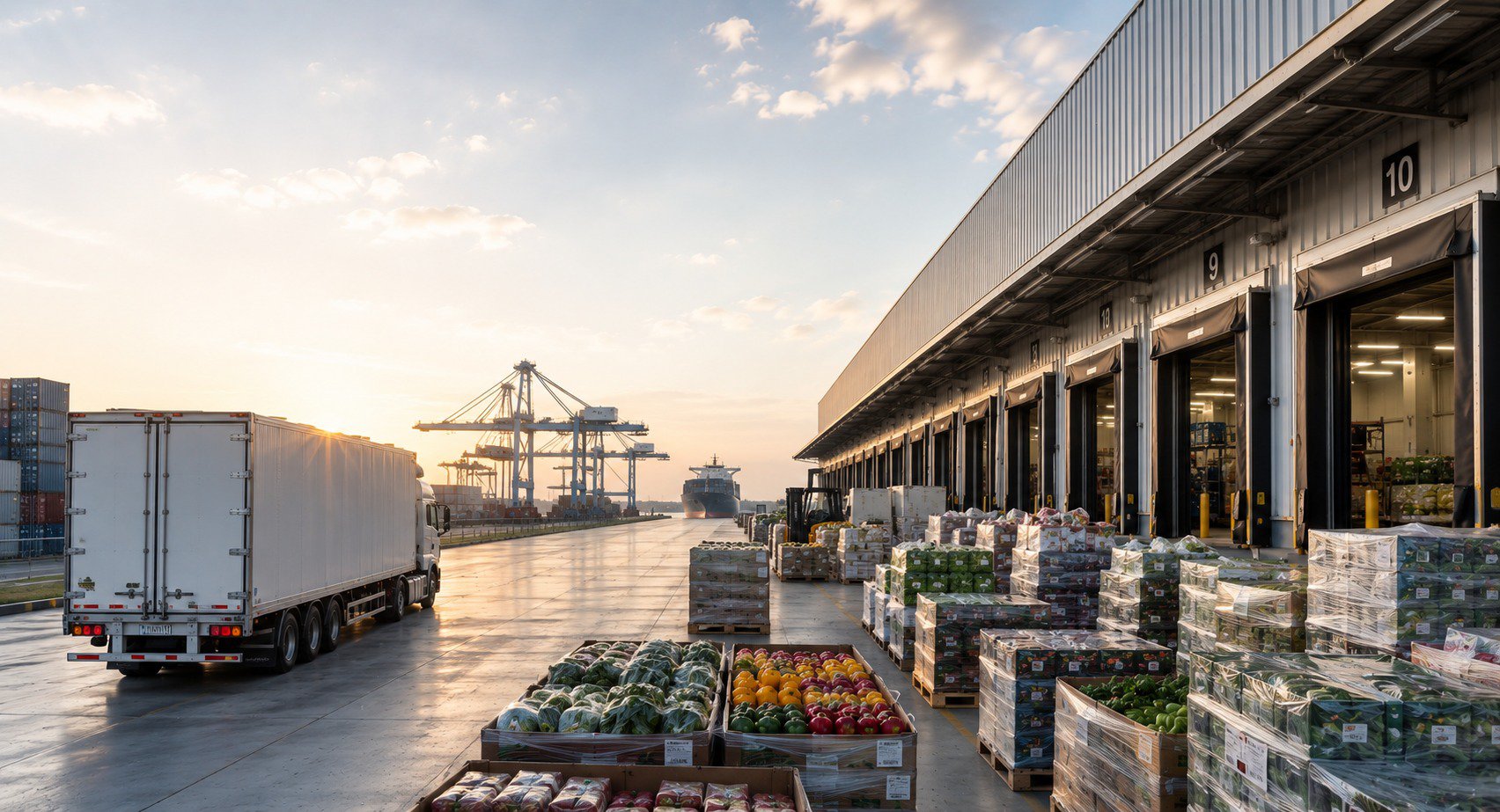


Importing and warehousing for perishable goods requires precise coordination from the moment a shipment leaves its origin until it reaches storage and distribution facilities.
Delays, documentation issues, or temperature fluctuations can quickly impact product quality and profitability.
MH Logistics helps businesses manage these challenges through customs brokerage, import coordination, and temperature-controlled warehousing solutions that keep products moving efficiently through the supply chain.
Perishable products move through highly time-sensitive supply chains where every hour matters.
Importers must balance customs requirements, transportation schedules, storage needs, and product shelf life while maintaining strict temperature controls throughout the process.
Here are the biggest challenges:
Also Read: Can A Customs Broker Handle Import And Export Documentation?
Here’s how MH Logistics can help with importing and warehousing of perishable goods:
Accurate documentation is one of the most important factors in successful perishable goods imports. Even minor errors can result in shipment holds, examinations, or clearance delays.
MH Logistics provides licensed customs brokerage services that support timely and accurate customs processing.
Our team works with clients to prepare and review required documentation before arrival, helping identify issues before they affect shipment movement.
Common documentation may include:
By coordinating documentation in advance and filing accurately with CBP and FDA before arrival, we help reduce unnecessary delays and improve overall supply chain efficiency.
For shipments that need to be held before duties are paid, or where entry timing depends on a downstream decision, bonded warehousing keeps product under customs control in a temperature-appropriate environment rather than accruing demurrage at the terminal. Importers managing seasonal volume or staged releases often use bonded storage to separate the clearance decision from the arrival date.
Perishable shipments often operate on tight timelines. Every additional hour spent waiting at a port, airport, or examination facility can affect product quality and available shelf life.
MH Logistics monitors shipment progress and coordinates closely with carriers, terminals, customs authorities, and other stakeholders throughout the clearance process.
This proactive approach helps keep shipments moving and allows our team to respond quickly when issues arise.
Also Read: Best Air Freight Charter For Urgent Shipments
Effective customs coordination involves more than submitting paperwork. It requires visibility, communication, and operational experience that supports efficient movement through complex international supply chains.
Physical preservation during the import phase requires continuous monitoring.
We equip our shipments with advanced IoT telemetry devices that transmit real-time data regarding internal container temperature, relative humidity, shock, and location via cellular or satellite networks.
If a reefer's genset fails on a terminal chassis, or a carrier sets an incorrect pulp temperature on a cooling unit, our global control tower receives an immediate automated alert.
Upon receiving a thermal variance alert, our team immediately contacts terminal operators, steamship lines, or port drayage partners to force a physical inspection and corrective action.
The critical link in the cold chain is the physical transfer from the ocean container or airport terminal to the warehouse storage environment.
This interface (often referred to as the "cold bridge") is where vulnerability spikes.
MH Logistics manages this transition through a tightly coordinated cross-dock and drayage protocol. Crossdock handling means product moves from the reefer into a temperature-controlled environment without an intermediate storage step, which removes one of the longest exposure windows in the entire import cycle. We utilize a dedicated fleet of refrigerated chassis and genset-equipped trucks to pull reefers from the terminal immediately upon discharge, minimizing exposure to unpowered terminal stacks.
This stage also provides an opportunity to identify discrepancies, verify quantities, review lot information, and ensure inventory records accurately reflect received products.
Once inside an MH Logistics facility, perishable goods enter an environment engineered specifically for preservation.
Our warehouses are multi-zone facilities capable of maintaining precise environmental profiles tailored to the specific biochemical needs of different commodities.
We eliminate cross-contamination and physiological damage by segregating goods based on their compatible temperature and humidity ranges, as well as ethylene sensitivity levels.
Also Read: Transporting Flowers From Farm To Retail
Our chilled storage zones cater to commodities requiring precise, non-freezing environments, typically ranging from 0°C to 4°C (32°F to 39°F).
These spaces are designed for fresh food and beverage products, dairy products, fresh proteins, and specific horticultural lines, each with different tolerance for temperature drift.
We manage not only the temperature but also relative humidity levels to prevent dehydration or mold development. Air circulation patterns are engineered to avoid cold spots or dead zones, ensuring an identical thermal profile from floor to ceiling.
For deep-freeze requirements, our blast freezing and frozen storage chambers operate continuously at temperatures ranging from -18°C to -25°C (-0.4°F to -13°F).
These environments are optimized for frozen seafood, meat and poultry, prepared foods, and specialized ingredients.
The architectural design utilizes thick insulated panels, under-floor ventilation systems to prevent frost heave, and rapid-roll insulated doors that minimize thermal exchange during pallet ingress and egress.
Perishable inventory requires dynamic management.
MH Logistics utilizes an advanced Warehouse Management System (WMS) built around First-Expired, First-Out (FEFO) picking logic.
Every inbound pallet is barcoded with lot-specific data, production dates, and expiration profiles, giving each lot full traceability from receipt through outbound distribution. The WMS automatically locks or flags product approaching its shelf-life thresholds, preventing expired or degraded items from entering outbound distribution streams.
Our inventory accuracy workflows include:
These processes help businesses maintain control over inventory while supporting customer service and compliance objectives.
Our facilities rely on continuous digital monitoring.
Industrial sensor arrays are distributed throughout our storage chambers to log environmental data at 5-minute intervals.
These systems are connected to redundant, off-site servers and backed up by automated generator networks capable of powering the entire facility in the event of a utility grid failure.
Facility controls also include employee training, equipment maintenance programs, sanitation procedures, and contingency planning.
Together, these elements create a warehouse environment capable of supporting perishables over extended storage periods.
Businesses need a logistics partner that understands the operational demands of importing and storing temperature-sensitive products.
MH Logistics coordinates every stage of the process to help reduce delays, improve visibility, and protect product integrity.
Here’s why so many businesses choose our 3PL services:
Managing multiple vendors across customs clearance, transportation, and warehousing can create communication gaps and increase operational complexity.
Working with a single full-service logistics partner helps streamline coordination and improve visibility throughout the supply chain. Information flows more efficiently, issues can be addressed more quickly, and accountability remains clear.
By integrating customs brokerage, transportation coordination, and warehousing support, MH Logistics helps businesses reduce risk while improving supply chain performance.
If you need importing and warehousing for perishable goods, you need a partner who treats the cold chain and compliance work as seriously as you do.
With temperature-controlled warehouses in New Jersey, Georgia, California, and Florida, plus over 15 years handling regulated and perishable freight, we keep your products and lanes protected from origin to final delivery.
Call us at 908-895-8605 or reach out through our contact page, and our team will help map out what your shipments need.